Current Events
Frome Concerts Group Presents: Voice
Sunday 1st February
Doors 2.15pm Concert 3pm
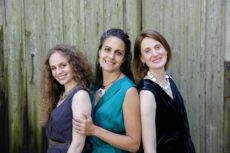
Victoria Couper/ Clemmie Franks /Emily Burn make up Voices
A mesmeric trio of voices at once timeless and ultra modern, Voice performs ‘Patterns of Love’, songs exploring the beauty, heartache and humour of love, from medieval to contemporary.
Patterns of Love is a programme of a cappella songs that explore the beauty, heartache and humour of love. The programme includes compositions from British composers, commissioned by Voice, as well as the trio’s own arrangements.
They open by dipping our toes into the rich harmonies of the vocal music of Georgia (Europe, not the States!). The first piece, Woisa, is an anonymous piece that plays with nonsense syllables as its text. It was taught to them by Davit Tsintsade on a visit to the UK. Batonebo is a healing song from Guria in the western part of Georgia. The words tell of a child lying ill and this song entices out the ‘Batonebi’ (literally Lords or Sirs) that are thought to cause illness by entering the child’s body. They originally learnt this song from British singer Vivien Ellis.
Composer Marcus Davidson first heard Voice singing in an underground venue in London in 2009. He was greatly inspired by both Hildegard’s music and the Georgian songs that he heard Voice perform, which moved him to write Angelica the Doorkeeper.
The duo of Shakespearean songs, begins with O Mistress Mine, referenced in Shakespeare’s Twelfth Night (2.3); there are three Elizabethan settings of this text by William Byrd, Thomas Morley, and John Gamble and since the melody in each of these is only slightly different, it can be assumed that this was possibly a contemporary folk tune of the time with its rather tongue-in-cheek lyrics. They balance this with the heart-break of The Willow Song, a three-part setting of the text and melody that may have been performed as Desdemona’s Lament in Shakespeare’s Othello (4.3).
They follow this with a group of English folk songs; the first two are tales of lost love, and the third is a cheeky tale where the female protagonist wins out. The Water of Tyne is a Northumbrian folk song, an old kingdom whose area fell between England and Scotland. Here the river Tyne flows fast and wide through the countryside. In the song, two lovers are separated by the wide banks of the river. The text was first printed in John Bell’s Rhymes of the Northern Bards (1812), and the tune was first published 70 years later in Bruce and Stoke’s Northumbrian Minstrelsy. O Waly, Waly tells a story of love that with time has grown old and ‘fades like the morning dew’. This arrangement uses the tune published by Cecil Sharp and Charles Marson in Folk Songs From Somerset (1906) created from an amalgamation of Elizabethan broadsheet lyrics and field recordings. Lovely Joan, was collected by Ralph Vaughan Williams (1872 – 1958). It’s playful, ironic, and the woman comes out on top. Voice arranged this song taking inspiration from RVW’s ‘Greensleaves’ harmonies, of which the tune of Lovely Joan became the counter-melody.
Tres Hermanicas and Trois Serours tell stories about three sisters and their experience of love. Tres Hermanicas is an arrangement of a traditional Sephardic ballad. Although some texts in this tradition point back to life in medieval Spain, following the trend of folk song collecting, most of these songs were notated at the beginning of the 20th century, and this one in particular indicates that it comes from Greece/Turkey when we learn that the errant daughter is banished to Rhodes, one of the Greek islands. Trois Serours is a secular, polyphonic motet found in a collection of 13th century French polyphony known as the Montpellier Codex. Voice was introduced to this piece by Stevie Wishart, who performed and recorded it with her group, Sinfonye.
Bien m’ont Amours entrepris is an arrangement of a trouvère song from the 13th century. Trouvères were the poet-composers of the courts of 12th and 13th century northern France. Like their contemporaries, the Occitan troubadours, and indeed those who followed on in the centuries to come, the subject of most of their poetry and song was “fin amour” or courtly love – chivalrous, noble, and forever out of reach. Also from the same century, S’on me regarde/Prennes i garde/HE MI ENFANT is another polyphonic motet also from the Montpellier Codex; a witty song with the lovers speaking in the first person, hiding from one another in a perfect example of an unrequited love-triangle.
Stevie Wishart’s Happy Song continues the musical theme of the polyphonic motet, in a somewhat unexpected fashion.. This piece first arrived in audio format and was workshopped with the composer to discover how best to make the sounds she had created digitally. The lyrics are in English, Latin, French, and Italian.
Caritas habundat, by the medieval abbess St Hildegard of Bingen (1098 – 1179), is a psalm antiphon for the Holy Spirit as Divine Love. Hildegard’s music holds a special place in Voice’s repertoire; they have recorded several of her works and have commissioned British composers to write pieces inspired by her words and music. Hildegard joined the monastery in Disibodenberg (in Germany’s Rhineland-Palatinate) when she was just eight years old and would stay there for nearly 40 years, eventually becoming abbess in 1136. Throughout her life, Hildegard was a great spiritual leader, theologian, mystic, scientist, and composer. Revered as a saint for centuries, Pope Benedict XVI canonised Hildegard on 10 May 2012.
Echo by Helen Chadwick sets a poem by Christina Rossetti (1830-1894) in a piece that was inspired by Voice’s unison sound. They collaborated with Chadwick through guided improvisation to form the harmonic passages that flow out of each verse.
They close the programme with two Scots songs. My Love is Like a Red, Red Rose is one of the most famous love songs associated with the Scottish poet, Robert Burns (1759 – 1796). The song was composed before 1794 and appeared in a collection by an Edinburgh singer and composer, Pietro Urbani. In the 19th century, the lyrics were paired with the well-known melody of another Scottish folk song, Low Down in the Broom, which is the one they perform tonight. Go Lassie, Go is an arrangement after Belfast musician Francis McPeake’s Wild Mountain Thyme. The lyrics and melody can be traced back to “The Braes of Balquhither” by Scottish poet Robert Tannahill (1774–1810) and Scottish composer Robert Archibald Smith (1780–1829). It is a beautiful folk song with references to the sprigs of thyme, mint or lavender that young women wore to attract a suitor and possibly to the Highland Clearances (1750 – 1860), perhaps making this a love song to Scotland herself.
We don’t print out programmes to save costs and paper! The musicians will introduce the pieces during the concert
“Brilliant trio…sensational singers” The Choir, BBC Radio 3 – Sara Mohr-Pietsch
Admission
Subcriptions for all four concerts £60. Single concert £16. under 21's half price. Tickets
Single concert tickets available from January 15